Stopping the leak: How European operators could save millions through pump efficiency
While electricity prices eased slightly in 2024, they remain well above historic levels. At the same time, carbon taxes continue to climb, with the cost of European permits rising from €7 per tonne in 2015 to €100 in 2023. BloombergNEF forecasts this could reach $156 per tonne by 2030.
In this environment, efficiency is no longer a choice - it’s a business imperative. Yet many operators still focus only on large equipment like turbines, compressors or boilers, overlooking the hidden cost of inefficient pumps.

Jorge Pilar, Equipment Optimization Specialist at Sulzer says:
“When operators think about reducing emissions or improving plant efficiency, pumps are often not top of mind. That’s a missed opportunity. These are energy-intensive assets that can quietly become major cost centres if performance isn’t monitored over time.”
Why pumps get left out – and why that’s changing?
Operators often assume that if a pump is running, it must be running efficiently. But that’s rarely the case. Many pumps, even those operating reliably, are drawing more energy than necessary due to outdated hydraulics, mismatched flow conditions or long-overdue retrofits. On the other hand, some operators might be unaware that their pumps are being operated in a limited or constrained mode.
This is common if the operators do not have an advanced analytics tool that can monitor a pump’s performance in real time against its original design. When this is compounded across large sites or major pipeline systems, the impact on energy use and carbon emissions can be substantial.
“Pump systems are typically viewed as reliable, long-life assets and therefore left out of the conversation around energy efficiency. But reliability doesn't always mean efficiency. Even well-functioning pumps can be silently drawing more power, increasing emissions and risking failures in surrounding systems. With the right data and approach, the savings potential is enormous - but it starts with recognizing that pumps are part of the solution, not the periphery”, Pilar adds.
Upgrades are sometimes dismissed due to perceived capital costs, especially where full replacements require infrastructure changes. But retrofits are changing the equation, often achieving payback in under two years and delivering reliability gains with minimal disruption.
Pilar concludes:
“One of the biggest misconceptions is that energy savings only come from major overhauls. In reality, efficiency losses build up from small mismatches - subtle shifts in operating conditions or changes in the wider system. Catching and correcting those is where the real value lies.”
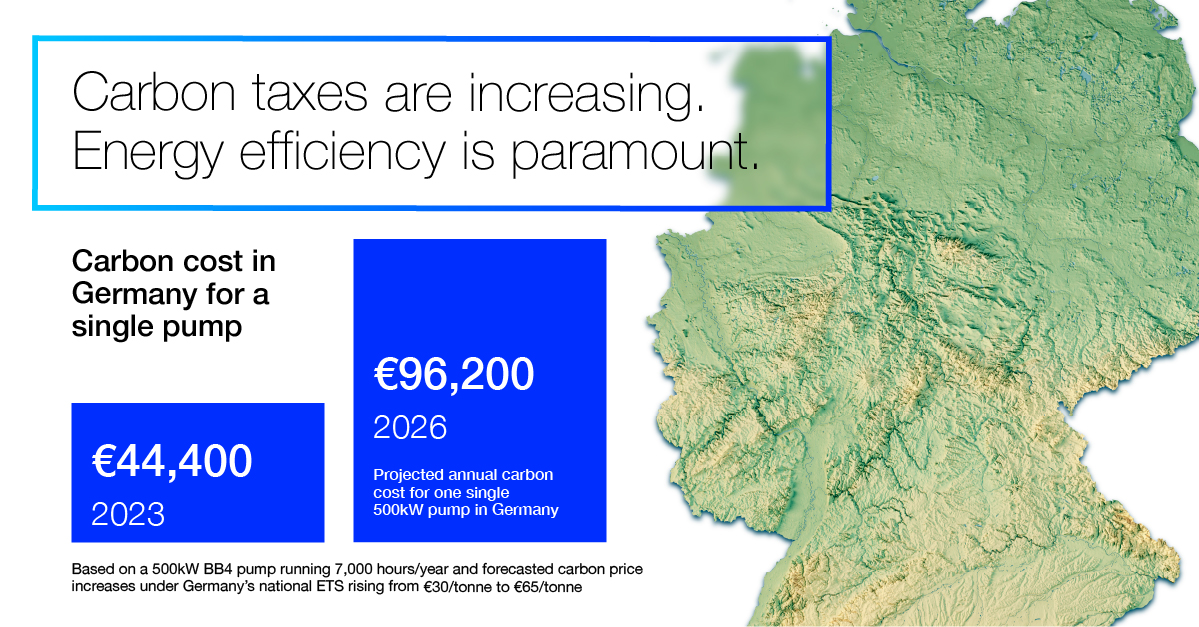
Longer-term paybacks are also becoming more acceptable, particularly in markets with aggressive carbon tax regimes. In Germany, the national emissions trading system is expected to raise the carbon price from €30 per ton in 2023 to €55–65 per ton by 2026. For example:
- An inefficient 500kWh BB4 pump running 7,000 hours a year would have cost around €44,400 in carbon certificates in 2023. By 2026, that figure could climb to €81,800–96,200.
Combined with energy savings, retrofits that previously failed internal thresholds may now be commercially attractive.
The multi-million-dollar opportunity hiding in plain sight – quantified
A recent study using data collected by Sulzer’s BLUE BOX™ advanced analytics solution found significant untapped saving opportunities across upstream, midstream and downstream operations. Downstream operations showed the most immediate potential, largely due to frequent fluid handling changes and a need to reuse legacy infrastructure. Upstream and midstream operators also stood to benefit significantly when looking across an entire fleet. The study discovered:
Efficiency improvements of this nature do not always require major structural change. Sulzer’s Energy Optimization Service provides a structured pathway: from diagnostic analysis to retrofit implementation and performance monitoring. Solutions include hydraulic re-rating, surface treatment of internal components, and mechanical upgrades to reduce energy losses. The result is a faster return on investment, often without significant plant disruption.
Proven results in the field
Audit reveals savings
per year uncovered at a Pakistani pipeline operator by assessing just four BB3 multistage pumps.
Retrofit delivers results
in annual savings and 7,750 tons of CO₂ emissions cut at a European oil company after upgrading four BB5 lean amine pumps.
Pump optimization in action
in annual energy savings delivered at a Spanish desalination plant, along with €1 million in cost reductions and 2,345 tons of CO₂ emissions cut after Sulzer boosted pump efficiency from 72% to 83%.
Ready to cut energy costs and boost efficiency?
Energy Optimization Service