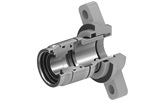
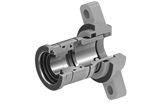
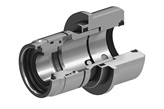
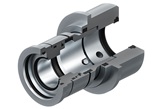
- Gotowe uszczelnienia są projektowane jako część oryginalna niektórych typów pomp odśrodkowych bez żadnych dodatkowych komponentów, aby uzyskać jak najwięcej miejsca między uszczelnieniem a pokrywą obudowy w celu zapewnienia niezawodnej pracy.
- Gotowe uszczelnienia są mocowane do pokrywy obudowy za pomocą standardowego kołnierza pompy lub za pomocą kołnierza uszczelnienia.
- Uszczelnienie jest mocowane na wale bez dodatkowych komponentów, takich jak tuleja wału, by uzyskać optymalną grubość ściany materiału, a tym samym bardzo niezawodną pracę.
- Gotowe uszczelnienia są proste i niezawodne, dzięki czemu ich instalacja i konserwacja są szybkie i łatwe. Nie wymagają one skomplikowanych zacisków regulacyjnych, tak jak uszczelnienia kasetowe.
Gotowe uszczelnienia
Uszczelnienia mechaniczne TB do niezawodnej pracy i szybkiej oraz łatwej konserwacji
Gotowe uszczelnienia mechaniczne TB1, TB1G, TB1F, TB1Q, TB1FQ i TB2P są przeznaczone do uszczelniania standardowej pokrywy obudowy uszczelniającej dławnicy i do standardowego wału bez dodatkowej tulei, do różnych typów pomp, takich jak pompy technologiczne z typoszeregu AHLSTAR A, APP, NPP, WPP.
- Pojedyncze uszczelnienie jest zaprojektowane tak, aby zmiany lub spadki ciśnienia pompowanego płynu nie otwierały powierzchni czołowych uszczelnienia.
- Podwójne uszczelnienie jest zaprojektowane tak, aby zmiany lub spadki ciśnienia po stronie pompowanego płynu lub uszczelnianego płynu nie otwierały powierzchni czołowych uszczelnienia. Powierzchnie czołowe uszczelnienia nie otwierają się także przy podciśnieniu.
- Powierzchnie czołowe spoczywają na elastycznych o-ringach, w związku z czym nie znajdują się pod żadnym kątem, ale są dokładnie wyrównane względem wału, co zapewnia długą i niezawodną pracę.
- Dzięki prostej konstrukcji gotowych uszczelnień koszt jest dużo niższy niż koszt kasetowych uszczelnień mechanicznych.
Specyfikacje techniczne, alternatywne materiały
| TB1/TB1G | TB1F/TB1Q/TB1FQ | TB2P | |
| P maks. | 25 barów | 25 barów | 25 barów |
| V maks. | 25 m/s |
25 m/s | 25 m/s |
T maks. |
125°C |
120°C z wewnętrznym przepłukiwaniem 180°C z zewnętrznym przepłukiwaniem |
180°C |
| Powierzchnie uszczelniające |
SiC/SiC, C/SiC | SiC/SiC, C/SiC | SiC/SiC-SiC/SiC SiC/SiC-C/SiC |
| Pierścienie o-ring |
EPDM, FKM | EPDM, FKM | EPDM, FKM |
| Inne części |
316 stainless steel (EN 1.4401, EN 1.4436), duplex EN 1.4462, super duplex EN 1.4410 |
316 stainless steel (EN 1.4401, EN 1.4436), duplex EN 1.4462, super duplex EN 1.4410 |
316 stainless steel (EN 1.4401, EN 1.4436), duplex EN 1.4462, super duplex EN 1.4410 |
Single mechanical seal
- Features a single pair of seal faces lubricated by the process fluid
- Suitable for non-aggressive, non-hazardous applications
Grease lubricated single seal
- Combines lubrication from the pumped liquid with an additional grease supply to the atmospheric side of the seal faces
- Ensures optimal lubrication and cooling of seal faces for reliable operation
- Provides enhanced protection for the seal and shaft components, extending service life
Flush single mechanical seal
- Includes a flush connection on the product side to enhance performance
- The product side of the seal chamber is flushed either with the pumped or clean liquid
- Removes contaminants, maintains lubrication, and regulates seal temperatures
- Offers significant cost savings, particularly in harsh or demanding environments
- Improves equipment reliability, efficiency, and reduces costs
Quench single mechanical seal
- Uses an external fluid on the atmospheric side to cool seal faces and remove contaminants, enhancing performance
- The quench feature enables a single mechanical seal to handle caustic, crystallizing, or oxidizing fluids in challenging applications
Double mechanical seal
- Comprises two pairs of seal faces constantly lubricated by an external fluid
- Ideal for demanding applications where the product cannot lubricate seal faces
- Commonly paired with a seal system to form a cooling and lubrication loop, it prevents dry running, extends seal life, and reduces sealing fluid use